Facility Management Journal (FMJ magazine) worked with Great Forest to offer a deep dive into waste audits and waste data. The report, Getting to the Bottom of Waste, uses data and case studies pulled from hundreds of Great Forest waste audit investigations conducted around the world.
It summarizes everything a facility manager or sustainability officer needs to know about waste audits and how they can be used to understand how waste is generated and discarded, and what to do to improve efficiency and reduce waste and costs.
Importantly, the report shares actual hard data from a real waste audit and reveals how the data is analyzed and interpreted.
Download the full FMJ article or scroll down to read more.
Getting to the Bottom of Waste
There is a saying that nothing in life is certain except death and taxes, but FMs know there is a third constant — waste. No matter where a facility is located, what business it serves or the number of people working at the site, there will always be waste. In addition to overflowing bins, there are contamination issues to worry about, rising disposal costs and more. The good news? Addressing waste is one of the easiest ways to make an impact on a facility’s sustainability goals, operational efficiency and bottom line, all at the same time.
To tackle waste, an FM must understand what is thrown out in all their waste streams, from trash to materials being collected for recycling and composting. This involves some down-in-the-dirt investigative work called a waste audit. Put simply, a waste audit is a waste investigation, where waste “detectives” in hazmat suits examine the contents of bags of waste from every waste stream they are auditing. The data they gather can be very illuminating.
Most trash isn’t trash
2025 Update: See updated waste data from the largest global waste characterization study conducted by Great Forest, with data from 100+ waste audits worldwide, analyzing 170,00 lbs of commercial waste.
A survey of the results of 100 waste audits in the United States revealed 77 percent of what is found in most commercial trash is not actually trash at all, but recyclable materials: 34 percent is made up of organics, 23 percent is paper, 19 percent is glass/ metal/plastic, and 1 percent is e-waste.
Only 23 percent of what many businesses are regularly throwing away could be considered “trash” in that the materials cannot be easily recycled and have reached what is considered their end life. This means that 77 percent of materials many businesses are paying to dispose of in landfills should not be going to landfills in the first place. Businesses are throwing away resources and money along with their trash. And that cost is rising.
Worldwide Trend Rising Waste, Rising Costs
In a 2018 report, the World Bank cautions that the amount of waste generated worldwide is expected to increase by 70 percent by 2050.
With the Chinese ban on the import of contaminated recyclables affecting almost every market in world, recyclable material which would previously have been shipped to China for processing, is now filling up landfills worldwide.
China is now only accepting recyclables with contamination rates under 1 percent. The U.S. recycling contamination rate can be as high as 25 percent.
Since the China import ban began in 2013, U.S. waste haulers and recyclers have been scrambling to figure out what to do with all the contaminated recyclables they receive. As a result, they have been charging higher fees to do more sorting at facilities, find new markets for the recyclables, or treat the contaminated recyclables as trash. In January 2019, analysts at Cass Information Systems detailed a 400 percent spike in contamination fees, with extra charges ranging from US$150-$250 per container.
Even in this volatile market, where the value of recyclables are generally dropping, the cost of recycling is still less than the cost of trash disposal. This is especially true as tipping fees — the charge for dumping trash in a landfill, which is often passed down to consumers—are constantly pushed up with the increasing amount of material headed to landfills.
According to a 2018 report from the Environmental Research and Educational Foundation, U.S. landfill tipping fees showed an average year-over-year 4.4 percent increase nationally from 2016 through 2018. Their report noted large increases in the Midwest (+18.3 percent), Northeast (+15.8 percent), and Pacific (+11.9 percent) over this period.
The Waste Business Journal also sees this upwards trend, predicting U.S. tipping fees would increase 6 percent to $53.53 per ton by 2021, from an average cost of $50.30 per ton in 2017.
With the waste industry still figuring out how to process all the waste material being generated, consumers, including business and buildings, are stuck with higher costs, unless they take control.
The Key to Control: Waste Audits
Those who control information, control the world. In this scenario, waste audits are the key to controlling waste. Waste audits are so important that in 2018 the San Francisco, California, USA, board of supervisors, passed an ordinance requiring the city’s largest waste generators to conduct waste audits every three years.
A waste audit provides a detailed waste characterization of a facility’s waste streams. It identifies what is being thrown away, what is being recycled or diverted through other means, and the amounts of each type of material by weight or volume.
- How many recyclables are ending up in the trash?
- Is trash contaminating recyclables?
- What is the most common type of waste being generated by a facility?
- Is a facility’s waste program operating efficiently?
- Is a facility paying too much for waste disposal?
A waste audit will provide data to answer all these questions, pinpoint problems, identify solutions and more. Here’s how:
CASE STUDY 1: Waste audit helps identify big waste problem, reduce waste and costs.
A waste audit at an office building revealed that a large percentage of their trash was made up of food scraps, which is heavy. By implementing an organics program to capture the food waste, the facility was able to make their waste load 25 percent lighter, significantly reducing their waste disposal fees, which was calculated by weight.
CASE STUDY 2: Waste audit helps reduce frequency of waste pickups and cost.
The dumpster at a manufacturing facility kept filling up rapidly and was constantly overflowing. The facility was forced to pay for more frequent pickups, which led to higher waste costs. A waste audit revealed that three-quarters of the dumpster was choked up with materials that could be diverted from the landfill.
The facility began pulling recyclables out of the waste stream. In less than a month, the facility was able to divert 15 tons from the landfill, and the volume of trash going to the landfill decreased by a 3 to 1 ratio, saving the facility an estimated 30-40 percent on its annual cost.
CASE STUDY 3: Waste audit helps with food waste strategy.
A U.S. fast-casual dining chain had policies and procedures in place to minimize food waste but their program did not distinguish between high quality, surplus food that could be donated, and inedible surplus food. A special food waste audit revealed that 64.8 pounds of quality food could be rescued and donated from three locations audited. The audit also revealed that without any reduction in food waste generation, the restaurant chain could rescue an average of 26.7 percent of its daily food waste to feed the hungry.
The audit provided the data the company needed to move forward with a planned regional food donation program, and to estimate their impact nationally as they considered a long-term food waste reduction strategy. Read the food waste audit case study.
Go for Zero Waste
With rising waste costs, the long-term solution for any facility is to move towards zero waste, following the lead of some of the world’s biggest companies, including Unilever, Procter & Gamble, GE and Subaru, along with a growing number of cities with zero waste goals. Whether facilities decide to go for zero waste in the long term, or to just focus on waste reduction for the short term, waste audits are a must. Without data from waste audits, FMs will not be able to get to the bottom of their waste problem and go for zero.
How to Read Waste Audit Data

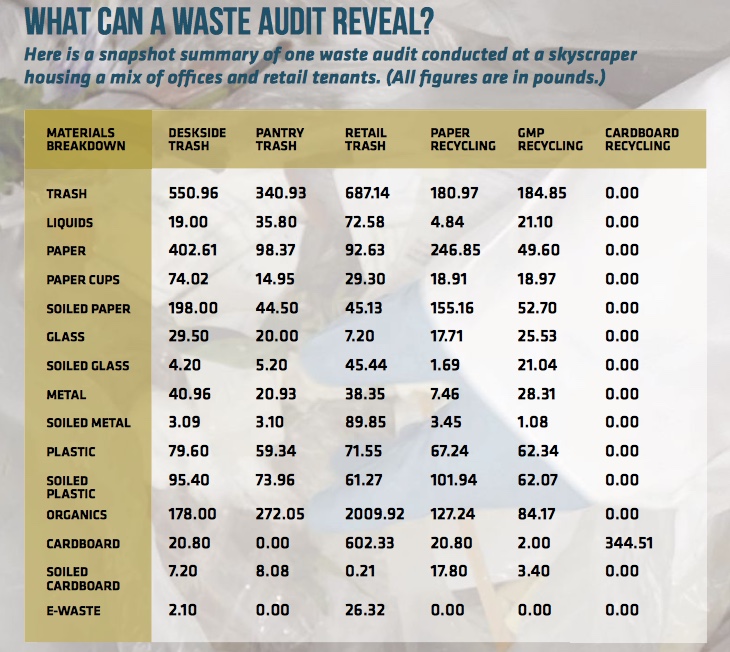
The snapshot above shows hard data from a real waste audit. What do the numbers mean? What does this waste audit reveal?
Click here to read a breakdown of the numbers and learn how to use this waste data to develop actionable insights that will move the needle on your waste program.
Learn More:
Waste Audit Benefits and Facts: What Every Business Needs To Know
Largest Global Commercial Waste Characterization Study: Insights from 100+ Waste Audits
Why Waste Audits Are Essential for Public Buildings: Learn More About the GSA’s Strategy